
🕒 4 min read
What is Harsh Turning?
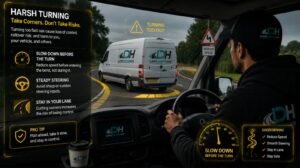
Harsh Turning is a safety event generated when Samsara AI detects that a vehicle has been steered through a corner or bend with excessive force or at a speed that exceeds safe driving limits.
Taking corners too quickly can reduce vehicle stability, increase tyre wear, cause loads to shift inside the vehicle, and increase the risk of losing control.
Drivers should always approach and negotiate bends, junctions and roundabouts smoothly and under full control.
⸻
How is it Measured?
Samsara AI uses vehicle telematics and camera data to monitor steering forces and vehicle movement throughout your journey.
A Harsh Turning event may be generated when cornering forces exceed Samsara’s configured event threshold.
To avoid Harsh Turning events, you should:
Reduce your speed before entering a bend or corner.
Steer smoothly without sudden movements.
Approach roundabouts and junctions under control.
Keep both hands on the steering wheel where possible.
Drive at a speed appropriate for the road and weather conditions.
⸻
Target
To achieve Fantastic performance, you should aim for:
0 Harsh Turning Events
Every journey should be completed using smooth, controlled steering and appropriate cornering speeds.
⸻
How the AI Detects It
Samsara AI combines vehicle telematics with footage from the road-facing camera.
The system may identify:
Excessive cornering forces.
Rapid steering inputs.
Vehicle speed whilst cornering.
The road conditions leading up to the event.
The severity of the manoeuvre.
The recorded footage helps provide context around why the turning event occurred.
⸻
What Causes It?
Harsh Turning events are commonly caused by:
Entering bends too quickly.
Taking roundabouts at excessive speed.
Sharp steering corrections.
Turning aggressively at junctions.
Swerving around parked vehicles or road hazards.
Failing to reduce speed before cornering.
Whilst some sudden steering manoeuvres may be necessary to avoid a collision, many Harsh Turning events can be prevented through better planning and speed management.
⸻
Best Practice
To consistently avoid Harsh Turning events:
Slow down before entering bends or roundabouts.
Brake before the corner, not during it where possible.
Steer smoothly and progressively.
Look through the bend and plan your route early.
Adjust your speed for weather, road surface and vehicle load.
Leave yourself enough time to complete every manoeuvre safely.
⸻
Real-World Examples
Examples of Harsh Turning include:
Entering a roundabout too quickly.
Turning sharply into a side road without reducing speed.
Swerving suddenly around a parked vehicle.
Taking a tight bend at excessive speed.
Making an aggressive steering correction after entering a corner too fast.
Cornering quickly whilst carrying a fully loaded van.
These situations reduce vehicle stability and increase the likelihood of losing control or shifting the load inside the vehicle.
⸻
Can This Be Challenged?
Some safety events may be reviewed if they have been recorded incorrectly.
Examples may include:
A sudden manoeuvre was required to avoid another road user.
An unexpected hazard made rapid steering unavoidable.
Roadworks or temporary traffic management affected the vehicle’s path.
The recorded footage does not accurately reflect the circumstances.
If you believe a Harsh Turning event has been recorded incorrectly or was caused by circumstances outside your control, report it to your manager as soon as possible.
Not every event can be overturned, but genuine exceptional circumstances may be investigated.
⸻
Why It Matters
Smooth steering is an essential part of safe and professional driving.
Following safe driving standards helps:
Protect you and other road users.
Reduce the risk of losing vehicle control.
Minimise load movement inside the vehicle.
Reduce unnecessary wear on tyres and suspension components.
Protect your Safety Score.
Demonstrate professional driving behaviour.
Every smooth and controlled turn contributes towards safer journeys, improved vehicle stability, and a better experience for everyone on the road.