🕒 4 min read
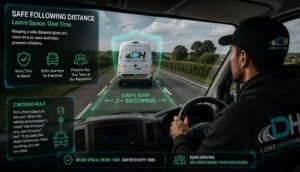
What is Following Distance?
Following Distance is a safety event generated when Samsara AI detects that your vehicle is travelling too closely behind the vehicle in front.
Maintaining a safe following distance gives you enough time to react to changing traffic conditions, avoid sudden braking, and reduce the risk of rear-end collisions.
Drivers should always leave sufficient space between their vehicle and the one ahead.
⸻
How is it Measured?
Samsara AI uses the road-facing camera and vehicle telematics to monitor the distance between your vehicle and the vehicle in front.
A Following Distance event may be generated if you remain too close to another vehicle whilst travelling above the configured speed threshold.
To avoid Following Distance events, you should:
Maintain a safe gap between your vehicle and the one ahead.
Increase your following distance in poor weather or reduced visibility.
Avoid allowing other drivers to influence your driving.
Anticipate slowing traffic well in advance.
Leave yourself enough time to react safely.
⸻
Target
To achieve Fantastic performance, you should aim for:
0 Following Distance Events
Every journey should be completed whilst maintaining a safe and appropriate gap from the vehicle ahead.
⸻
How the AI Detects It
Samsara AI continuously analyses the road ahead using the forward-facing camera alongside vehicle speed data.
The system may identify:
The distance between your vehicle and the vehicle ahead.
How long you remain within an unsafe following gap.
Your vehicle speed.
Traffic conditions leading up to the event.
The AI assesses whether sufficient stopping distance has been maintained throughout the journey.
⸻
What Causes It?
Following Distance events are commonly caused by:
Tailgating the vehicle ahead.
Driving too closely in slow-moving traffic.
Failing to increase your gap as speed increases.
Allowing yourself to become impatient behind slower vehicles.
Not anticipating traffic slowing ahead.
Leaving insufficient space in poor weather conditions.
The closer you drive to another vehicle, the less time you have to react if they brake suddenly.
⸻
Best Practice
To consistently avoid Following Distance events:
Follow the two-second rule in dry conditions.
Increase your gap to at least four seconds in wet weather and even more in ice, snow or fog.
Scan well ahead to identify hazards early.
Ease off the accelerator rather than braking late.
Never allow other drivers to pressure you into driving too closely.
Create additional space whenever traffic conditions allow.
⸻
Real-World Examples
Examples of Following Distance include:
Driving close behind another van on a dual carriageway.
Remaining directly behind slow-moving traffic with little room to react.
Closing the gap whilst approaching traffic lights.
Following another vehicle too closely through roadworks.
Not increasing your distance during heavy rain.
Driving closely behind a vehicle approaching a junction.
These situations significantly reduce your available reaction time if the vehicle ahead stops unexpectedly.
⸻
Can This Be Challenged?
Some safety events may be reviewed if they have been recorded incorrectly.
Examples may include:
Another vehicle suddenly changes lane directly in front of you.
Traffic conditions temporarily reduce the available gap.
The AI incorrectly interprets surrounding traffic.
The recorded footage does not accurately reflect the circumstances.
If you believe a Following Distance event has been recorded incorrectly, report it to your manager as soon as possible.
Not every event can be overturned, but genuine false positives or exceptional circumstances may be investigated.
⸻
Why It Matters
Maintaining a safe following distance is one of the simplest and most effective ways to prevent collisions.
Following safe driving practices helps:
Protect you and other road users.
Reduce the likelihood of rear-end collisions.
Improve reaction time to unexpected hazards.
Reduce harsh braking events.
Protect your Safety Score.
Demonstrate professional driving behaviour.
Leaving yourself enough space gives you more time to react, improves vehicle control, and helps create a safer journey for everyone on the road.