

🕒 3 min read
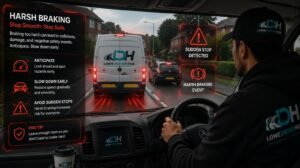
What is Harsh Braking?
Harsh Braking is a safety event generated when Samsara AI detects heavy or sudden braking that exceeds normal driving levels.
Whilst emergency braking is sometimes unavoidable, frequent Harsh Braking events often indicate that hazards are being identified too late, following distances are too short, or road conditions are not being anticipated effectively.
Drivers should always aim to brake smoothly and progressively wherever possible.
⸻
How is it Measured?
Samsara AI uses vehicle telematics and camera data to monitor braking throughout your journey.
A Harsh Braking event may be generated when the vehicle decelerates sharply enough to exceed Samsara’s event threshold.
To avoid Harsh Braking events, you should:
Look well ahead and anticipate changing road conditions.
Maintain a safe following distance.
Reduce your speed early when approaching hazards.
Brake smoothly and progressively whenever possible.
Allow plenty of time to stop safely.
⸻
Target
To achieve Fantastic performance, you should aim for:
0 Harsh Braking Events
Every journey should be completed using smooth, controlled braking whenever it is safe and practical to do so.
⸻
How the AI Detects It?
Samsara AI combines data from the vehicle’s telematics with video footage from the road-facing camera.
The system may identify:
Sudden or excessive deceleration.
Heavy braking immediately before a hazard.
Braking that exceeds the configured event threshold.
The road conditions leading up to the braking event.
The recorded footage helps provide context around why the braking occurred.
⸻
What Causes It?
Harsh Braking events are commonly caused by:
Following the vehicle ahead too closely.
Driving too fast for the road or traffic conditions.
Leaving braking until the last moment.
Failing to anticipate traffic slowing ahead.
Late reactions to pedestrians, cyclists or other road users.
Unexpected hazards requiring emergency braking.
Not every Harsh Braking event indicates poor driving. In some situations, emergency braking is the safest and most appropriate response.
⸻
Best Practice
To consistently avoid Harsh Braking events:
Scan well ahead rather than focusing only on the vehicle directly in front.
Leave a safe following distance at all times.
Ease off the accelerator early when approaching junctions, roundabouts and traffic lights.
Read the road ahead and anticipate developing hazards.
Adjust your speed for weather, traffic and road conditions.
Always prioritise safety over avoiding an event.
⸻
Real-World Examples
Examples of Harsh Braking include:
Braking heavily because traffic suddenly stops ahead.
Approaching a roundabout too quickly before braking sharply.
Leaving insufficient distance behind another vehicle.
Reacting late to a changing traffic light.
Braking suddenly for a pedestrian or cyclist.
Failing to anticipate queuing traffic around a bend.
Although some situations are unavoidable, many Harsh Braking events can be prevented through better planning and observation.
⸻
Can This Be Challenged?
Some safety events may be reviewed if they have been recorded incorrectly.
Examples may include:
Another road user creates an unavoidable emergency.
A vehicle suddenly pulls into your stopping distance.
A pedestrian unexpectedly enters the carriageway.
The event appears inconsistent with the recorded footage.
If you believe a Harsh Braking event has been recorded incorrectly or was caused by circumstances outside your control, report it to your manager as soon as possible.
Not every event can be overturned, but genuine exceptional circumstances may be investigated.
⸻
Why It Matters
Smooth braking is a key part of safe and professional driving.
Maintaining good braking habits helps:
Protect you and other road users.
Reduce the risk of rear-end collisions.
Improve passenger and load stability.
Reduce unnecessary wear on tyres and brakes.
Protect your Safety Score.
Demonstrate professional driving behaviour.
Every well-planned stop contributes towards safer journeys, improved vehicle control, and a better experience for everyone on the road.